ABOUT THE GAME
About Crazy Goal : Soccer Stickman
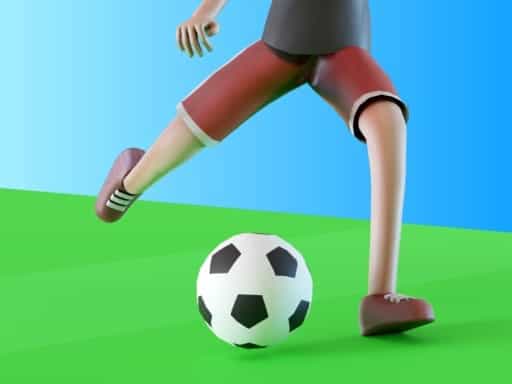
Draw a line to kick the ball. The direction and route of the ball are completely controlled by you. Use your wisdom to solve puzzles and score top notch goals!
QUICK FACTS
- Category
- Sports
- Platform
- Browser (PC & mobile)
- Control
- Use your mouse to draw a line on the screen - this line represents the path your stickman will follow when kicking the ball.
- Orientation
- Landscape
- Developer
- Not specified
CONTROLS
Control
Use your mouse to draw a line on the screen - this line represents the path your stickman will follow when kicking the ball.
Control
Consider the starting position of the ball and the location of the goal when planning your trajectory.
Control
Account for obstacles that may block straight-line paths and plan accordingly.
Control
Once you've drawn your intended path, release the mouse button to have your stickman execute the kick.
SCREENSHOTS
In-Game Screenshots

Why Crazy Goal : Soccer Stickman Keeps Pulling Players Back
Crazy Goal : Soccer Stickman takes the most satisfying moment in soccer - scoring - and turns it into a puzzle you solve before the ball ever moves. Instead of timing a kick or dribbling past defenders, you draw the ball’s entire trajectory with a line, release, and then watch your stickman execute the plan you sketched. That planning-first twist is what makes the game addictive: every level is a small geometry problem, and every goal you score is a proof that you solved it.
The game is also generous with its difficulty curve. Early levels are straightforward - a clear lane to the goal, an easy angle. Then walls appear, barriers block the direct route, moving elements shift the geometry, and suddenly you are planning bounces and ricochets the way a billiards player plans a bank shot. The stickman’s exaggerated animations give each success a personality, and the puzzle satisfaction of a well-executed plan lands harder than any reflex-based goal ever could.
It is the kind of game where thinking feels good. The controls are minimal - draw and release - but the space of possible solutions is wide, and finding the clever route that a level’s layout is clearly asking for is deeply rewarding. That combination of low barrier to entry and real spatial depth is why players keep coming back for one more level.
What a Well-Planned Goal Actually Looks Like
A perfect shot in Crazy Goal is planned before it is taken. The core loop is: study the layout, understand where the ball starts, where the goal sits, and what stands between them; then draw a path that respects the obstacles; release and watch the stickman execute your route.
| Step | What you are evaluating | The key question |
|---|---|---|
| Read | Ball position, goal position, obstacles | What blocks a straight line? |
| Plan | Candidate routes around the obstacles | Which route uses geometry, not luck? |
| Draw | The trajectory on screen | Does the line avoid every obstacle? |
| Execute | The stickman follows your line | Did the path reach the goal? |
| Adjust | The failed attempt teaches you something | What did the layout reveal? |
The crucial mental shift is that you are not kicking a ball - you are drawing a route for a character to follow. The stickman will move exactly along the line you sketch, so the quality of the plan entirely determines the quality of the shot. Account for the starting position, the goal’s location, and every obstacle that could interrupt the path before you commit to a line.
Drawing Lines That Beat the Geometry
The drawing mechanic is simple in execution and deep in planning. Use your mouse to draw a line on the screen - that line is the path your stickman will follow. Consider the starting position of the ball and the location of the goal first. Then look at the obstacles: anything that blocks a straight line is a signal that your route needs to bend, bounce, or use the environment.
The key to good trajectory planning is thinking in terms of angles. If a wall blocks the direct lane, the wall is not an obstacle - it is a tool. A ball that bounces off a barrier can curve around defenders or reach a goal that no straight line could touch. Bounce off one surface to change direction, and you open routes that look impossible on the first read.
| Situation | Straight line? | Better approach |
|---|---|---|
| Clear lane | Yes - draw it directly | The simplest correct plan |
| Wall blocking the lane | No | Bounce off the wall at the right angle |
| Moving obstacle in the path | Depends on timing | Draw a route that clears it or waits it out |
| Goal at an awkward angle | Rarely | Use a double-bounce route |
Techniques That Turn a Good Shot into a Great One
Once you understand the geometry, the game opens up. The best habits:
- Look before you draw. Study the full layout first - where the ball starts, where obstacles sit, where the goal waits - before sketching anything.
- Use the walls. A bounce can do what no straight line can. The angle of the draw determines the angle of the ricochet.
- Watch the moving elements. Obstacles that move are timing problems; plan a path that arrives when the space is clear.
- Learn from every miss. A failed attempt is information - the layout just told you which route does not work.
- Think in the stickman’s perspective. The character follows your line exactly, so a clean, smooth line produces a clean, smooth execution.
Mistakes That Miss the Goal
The most common failure in Crazy Goal is treating it like a timing game. Drawing a quick diagonal toward the goal without studying the obstacles is the number one way to waste an attempt. A second mistake is ignoring the walls entirely - players see a barrier and assume the level is impossible, when the wall is actually the intended route. And a third is overcomplicating: drawing long, fancy curved lines when a simple bounce would do.
| Mistake | The result | The fix |
|---|---|---|
| Drawing without studying | The ball hits a wall | Read the layout before you draw |
| Ignoring walls and barriers | Routes look impossible | Treat surfaces as tools, not obstacles |
| Overcomplicating the line | Unnecessary risk of failure | Prefer the simplest line that works |
| Rushing the release | Sloppy execution | Draw deliberately, then release |
The Puzzle of Progressive Levels
Every level in Crazy Goal is a new spatial puzzle, and the progression is designed to teach you geometry gradually. Early levels establish the basics - draw a line, reach the goal. Later levels introduce walls, barriers, moving elements, and layouts where the obvious route is a trap and the real solution requires a clever ricochet. The game rewards the player who thinks in angles and bounces over the player who relies on reflexes, and that is exactly why each success feels earned.