

ABOUT THE GAME
Rocket Goal, Explained
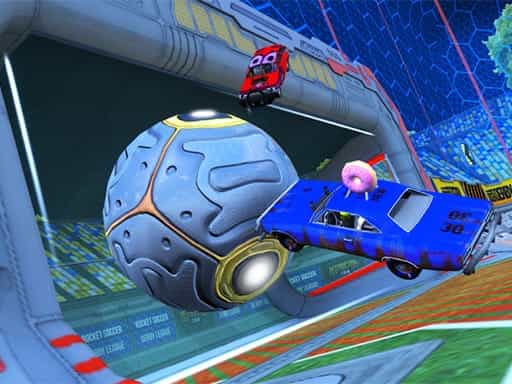
Ever wanted to play car soccer but your browser? Rocket Goal lets you hop into a rocket-powered vehicle and smash a giant ball into the opponent's net. No downloads, no installs — jump in and score.
QUICK FACTS
- Category
- Sports
- Platform
- Browser (PC & mobile)
- Control
- WASD to move, K to jump, J to boost
- Orientation
- Landscape
- Developer
- Not specified
THE CORE LOOP
What a Good Match Looks Like
Kick off
Drive into the arena and fight for the giant ball from the center.
Boost and dribble
Grab gold boost pads and carry the ball toward the opponent's net.
Smash it in
Bounce the ball off your hood or hit it hard into the goal to score.
Win the match
Most goals when time runs out wins the match and raises your rank.
CONTROLS
Move
WASD
Jump
K (double-tap to flip)
Boost
J
Drift
Shift
Air roll
Q / E
Ball Cam
Space
Pause
P
QUICK TIPS
- Hold J to burn nitro for speed bursts, but keep an eye on your meter.
- Grab gold boost pads around the arena to refill your nitro.
- Tap Space to lock the camera on the ball — essential for tracking plays.
- Double-tap K mid-air to flip and change direction quickly.
- Pass to teammates in 2v2 and 3v3 to set up open-net plays.
GAME NOTES
Controls and Your First Kick-off
Start the match
Press Play Now to load Rocket Goal in your browser — no download needed.
Learn the controls
WASD moves your car, K jumps, J boosts, Shift drifts, Space toggles Ball Cam.
Score the goal
Drive the ball into the opponent's net — most goals when time runs out wins.
MORE FOR THIS GAME
More Ways to Play
SCREENSHOTS
In-Game Screenshots

Why Rocket Goal Keeps Players Coming Back
Rocket Goal delivers the car-soccer fantasy that Rocket League made famous, but it does it entirely in your browser - no download, no install, no 40-gigabyte update sitting in your library. You hop into a rocket-powered vehicle, grab gold boost pads scattered around the arena, and smash a giant ball into the opponent’s net. It sounds simple. The physics make it absorbing.
The magic is in the feel. When the ball bounces off your hood at an angle, it bounces the way real momentum suggests. When you hit it at full boost, it launches. When you misjudge a touch, the ball goes somewhere you did not intend - and that honesty is exactly what makes the skill ceiling real. You are not fighting the game; you are learning its physics, and every match teaches you something you can use in the next one.
It also earns its place as the flagship game on this site because it matches how players actually behave: sessions are short, goals are easy to read, and one score is rarely enough. The ranked ladder, the vehicle unlocks, and the team modes all feed the same loop - one more match, one more chance to score a goal you will want to watch again.
What a Good Match Actually Looks Like
A good match in Rocket Goal is not about doing everything yourself - it is about doing the right thing at the right moment. The core loop repeats the same beats: kick off, fight for the ball, boost toward the opponent’s net, and smash it in. The skill is in the details between those beats.
At kick-off, the first contest decides the opening attack. Players who reach the ball first with a boost advantage usually win that exchange, so the opening sprint matters. After that, the game becomes a question of positioning: being between the ball and your own net makes you a defender; being on the ball’s far side makes you the attacker. Good players switch between those roles constantly, reading where the ball is going rather than where it is.
The flow of a good match looks like a series of small wins: a clean boost grab, a solid touch that keeps possession, a save that turns defense into attack, and finally a goal that came from positioning more than luck. Matches are short, so every one of those small wins compounds - the team that wins the most exchanges almost always wins the scoreline.
Steering, Boosting, and the Inputs That Win Matches
The control scheme is designed to be learnable in one match and masterable over many. Here is the full input map:
| Action | Input | What it does |
|---|---|---|
| Move | WASD | Steer your car around the arena |
| Jump | K | Launch off the ground (double-tap to flip) |
| Boost | J (hold) | Burn nitro for speed bursts |
| Drift | Shift (hold) | Tight cornering and sharper turns |
| Air roll | Q / E | Rotate in the air for better landings |
| Ball Cam | Space | Lock the camera on the ball |
| Pause | P | Pause the match |
The important insight is that these inputs combine. Boost while steering to carve wide, fast arcs. Jump, then double-tap K mid-air to flip and redirect your momentum. Hold Shift into a corner to drift through it while keeping your speed. The game does not ask you to learn eight separate skills - it asks you to learn how the inputs layer on top of each other.
Most new players start by driving and boosting, which is correct. The jump, the flip, and the air roll are the tools that separate midfield runners from match-winners, but they matter most once you understand the ball’s behavior. Learn the movement first, then add the aerial layer.
Boost Management: When to Burn and When to Save
Boost is the most important resource in Rocket Goal, and how you manage it decides more matches than any other skill. The arena is dotted with gold boost pads - driving over them refills your meter - and your own boost regenerates, but the pads are the difference between always having speed and always running empty.
The rule of thumb is simple: burn boost when it wins you something, save it when it does not. Reaching a contested ball first wins you the touch - that is worth full boost. Chasing a ball that is already past you, or boosting in a straight line with no opponent near, is usually a waste. The best players are constantly asking whether the boost they are spending will change the next two seconds.
There is also a rhythm to boost collection. Good players do not chase pads randomly; they route their movement through the pads, collecting them on the way to where they need to be. A defender retreating toward their own net can collect a line of pads while getting into position. An attacker carrying the ball can dip toward a pad cluster mid-dribble. Boost management is really movement planning - the pads are breadcrumbs laid out for players who know where they are going.
Reading the Ball: Positioning and Ball Cam
The single biggest improvement most players can make is learning to read where the ball is going, not where it is. The ball in Rocket Goal is a physics object - it bounces off walls, rolls along the floor, and deflects off cars. Its future position is readable, and the players who read it are always one step ahead.
Ball Cam (Space) is the tool that makes this possible. With the camera locked on the ball, you can see its trajectory and the space around it, which tells you where to position your car. The habit to build is toggling it intelligently: Ball Cam for tracking the play, and the standard camera when you need to line up a precise touch or collect boost without losing your bearings.
Positioning follows from reading. When the ball is in the opponent’s half, your job is to be behind it, ready to attack. When the ball is in your half, your job is to get between it and your goal. The players who look like they are always in the right place are not faster - they are just reading the ball’s path and moving to meet it instead of chasing it.
Dribbling and Carrying the Ball Under Control
Dribbling in Rocket Goal is not like dribbling in football - you are not touching the ball with feet, you are carrying it on your car. The ball can ride on your hood as you drive, and a well-controlled carry lets you move the ball where the defenders are not.
The basic dribble is simple: get under the ball, match its speed, and drive. The ball sits on your car as long as your speed matches its momentum. From there, you can accelerate to push it forward, or brake slightly to let it roll off your hood in a controlled direction.
The advanced version is the flick. When you have the ball on your hood, jumping and flipping forward launches the ball - the flip transfers your car’s momentum into the ball, sending it high and fast toward the goal. A well-timed flick is one of the most dangerous attacks in the game, because it is fast, hard to read, and very hard for a goalkeeper to save. Practice the carry first - the flick is a reward for players who have mastered control.
Aerial Play: Jumps, Flips, and Air Rolls
The aerial layer is where Rocket Goal separates its players. Jumping lets you leave the ground; double-tapping K mid-air lets you flip; and the air roll controls (Q/E) let you rotate your car while airborne. Combined, they let you hit balls that are in the air - and in a game where the ball bounces off walls and floats over heads, aerial play wins matches.
The first aerial skill is the simple jump-and-hit: jump toward the ball and make contact with your car to redirect it. The second is the flip: double-tap K while airborne to rotate your car, which adds power to the touch and lets you hit the ball in directions you could not reach with a plain jump.
Air rolling is the finishing tool. When you jump for a ball at an awkward angle, air roll lets you adjust your car’s orientation mid-flight, so you make contact with the part of your car that directs the ball where you want. It takes practice, but the payoff is the ability to make clean, powerful touches on balls that would otherwise sail past.
Passing and Team Play in 2v2 and 3v3
Rocket Goal’s team modes reward passing, and passing is something most new players ignore. The instinct is to touch the ball every time you are near it - but the best teams touch it only when the touch improves the situation.
A pass in Rocket Goal is any touch that gives a teammate a better position than you have. If you are carrying the ball toward the corner and a defender is closing, a pass into the center where your teammate is waiting is worth more than forcing a shot from a bad angle. The golden rule is simple: if you are not in a good position to score, find the teammate who is.
Positioning for the pass is the other half. Teammates should spread out, giving the ball carrier options instead of crowding the same space. The classic setup is one player carrying the ball wide while the other waits in the center for the cross. Learning to read when your teammate is open - and moving into the open space when you are the support player - turns a team of individuals into a team that scores.
Defense: Saves, Rotations, and Protecting Your Net
Defense in Rocket Goal is not a role - it is a responsibility every player shares. The team that concedes cheap goals loses, no matter how many they score, so learning to defend is how you win games you have no right to win.
The first defensive skill is positioning: when the ball is in your half, be between it and your goal. The second is the save: timing your touch so you clear the ball before it crosses the line. A well-timed save is not just defense - it is the start of an attack, because the ball you clear is the ball your teammates can chase.
The third skill is rotation. When your teammate commits to an attack, someone needs to drop back to cover the goal - if everyone attacks, one cleared ball becomes an open-net goal against you. The discipline of rotating, of being the player who stays home while your teammates push, is what separates teams that concede from teams that win.
Vehicles, Ranks, and Progression
Progression in Rocket Goal runs through two systems: the garage and the ladder. The garage starts you with the Vortex and unlocks faster, more distinctive rides - Overdrive, Crimson, Nitron and more - as you rank up. The ladder runs from H rank up to S rank, climbing as you win matches and collect trophies.
The vehicles are more than skins. They handle differently, and players develop preferences for the car that matches their style - a car with better acceleration suits a dribbler, while a car with top speed suits a defender who needs to cover ground. The progression is designed so that the cars you unlock change how you play, not just how you look.
The ranked ladder gives every match a stake. Winning matches climbs you toward S rank, and the trophies you collect are the visible record of your climb. It is a progression that rewards consistency - the players who rank up are the ones who win regularly, not the ones who score one spectacular goal and lose the rest.
Game Modes: Practice, Matchmaking, and Private Rooms
Rocket Goal offers three ways to play, and each one serves a different purpose. Practice mode is the free-training sandbox - the place to learn the controls, drill the carries and flicks, and build the muscle memory that carries into real matches.
Online matchmaking is the core experience - drop in, get matched, play a competitive match against players near your level. It is where the ranked ladder lives, and it is where the game’s skill ceiling shows itself: the players you meet will punish your mistakes and teach you what you need to learn.
Private rooms are the social layer. Create a room, share the invite code, and play against friends. Private rooms are where the game becomes a party - same physics, same ball, but the stakes are bragging rights, and the matches are usually funnier. Between the three modes, there is always a reason to open the game: practice when you want to improve, matchmaking when you want competition, and private rooms when you want to play with people you know.
Common Mistakes That Give Up Goals
Every player makes the same mistakes when they start, and recognizing them is the first step to fixing them. The most common is ball-chasing - every player on the team converging on the ball at once, leaving the goal wide open. The fix is positioning: spread out, let one player challenge, and keep someone between the ball and the net.
The second is boost waste. Boosting in straight lines with no purpose leaves you empty when the important play happens. The fix is intention - every boost spend should be moving you toward a touch, a pad, or a defensive position.
The third is forcing touches. Hitting the ball just because you are near it often gives it away, setting up the opponent’s attack. The fix is judgment - a touch is only worth it if it improves your team’s position. And the fourth is ignoring defense entirely, playing as if every match is an all-out attack. The teams that win are the ones that understand the ball will come back, and they are ready for it.
| Mistake | Why it concedes | The fix |
|---|---|---|
| Ball-chasing | Open net behind everyone | Spread out and rotate |
| Wasting boost | Empty when it matters | Spend with intention |
| Forcing touches | Giveaways | Touch only when it helps |
| Ignoring defense | Cheap goals | Keep someone home |
Frequently Asked Questions
Can I play Rocket Goal in the browser? Yes. Rocket Goal runs directly in the browser on desktop and mobile devices, with no download or install required - the game loads in the player above, and cross-platform cloud saves carry your progress between browser, iOS, and Android.
Is Rocket Goal free to play? Yes. The full game is free - practice mode, online matchmaking, private rooms with invite codes, and the ranked ladder are all included. The vehicle unlocks are earned through progression, not purchases.
Why does the game feel slow on my device? Rocket Goal runs best in a current browser with hardware acceleration enabled. On low-end devices, close background tabs and make sure your browser is up to date - the game also works on mobile browsers, where a touch-friendly control layout is available.
How do I get better at aerials? Start with the jump, then add the flip, then the air roll - in that order. Use practice mode to drill the sequence without pressure: jump toward the ball, double-tap K to flip into the touch, and use Q/E to adjust your angle. Ten minutes of practice beats fifty minutes of failing in matches.
What does Ball Cam actually do? Ball Cam (Space) locks your camera on the ball so you can track the play and read the ball’s trajectory. Toggle it off when you need to line up a precise touch or collect boost - the best players switch between the two constantly.
How does the ranked ladder work? Winning matches earns trophies and climbs you from H rank toward S rank. The ladder rewards consistency - players who win regularly rank up, while players who rely on single spectacular moments stay where they are.
FAQ
Rocket Goal FAQ
Can I play Rocket Goal in the browser?+
Yes. Rocket Goal runs directly in the browser on desktop and mobile devices, with no download or install required.
Is Rocket Goal free to play?+
Yes. The game is free to play, with online matchmaking, private rooms and practice mode all included.